Symmetric Generation
Recently I’ve been messing around with Pygame as a means to explore topics like cellular automata, procedural generation, and emergent behavior (inspired by Emergent Garden). I am by no means an expert in any of these subjects and truly have only really dug into them over the past couple weeks.
An exercise in procedural generation that I’ve been doing the past few days is finding a way to generate caves and tunnels that look similar to those in the game Terraria. Now, I could probably go and research exactly how Terraria caves are generated and exactly what algorithms they use, but I wanted to screw around and figure it out myself. In doing this, I’ve found that I run into a pretty strange problem in generating terrain.
To understand the problem, we should look at how my caves are generated as of right now.
My caves are created as a 2d array of “cells” (representing a 2d plane) where a cell is singular block in the terrain. The terrain is represented on the back-end with a bitmap where a 1 represents a cell and a 0 represents open air. The first step of generation is initializing each cell in the world to a random 0 or 1 using the following function:
def init_board():
    for i in range(COLS):
        for j in range(ROWS):
            active = random.randint(0, 1)
            board[i][j] = active
This function produces a world that looks something like this:
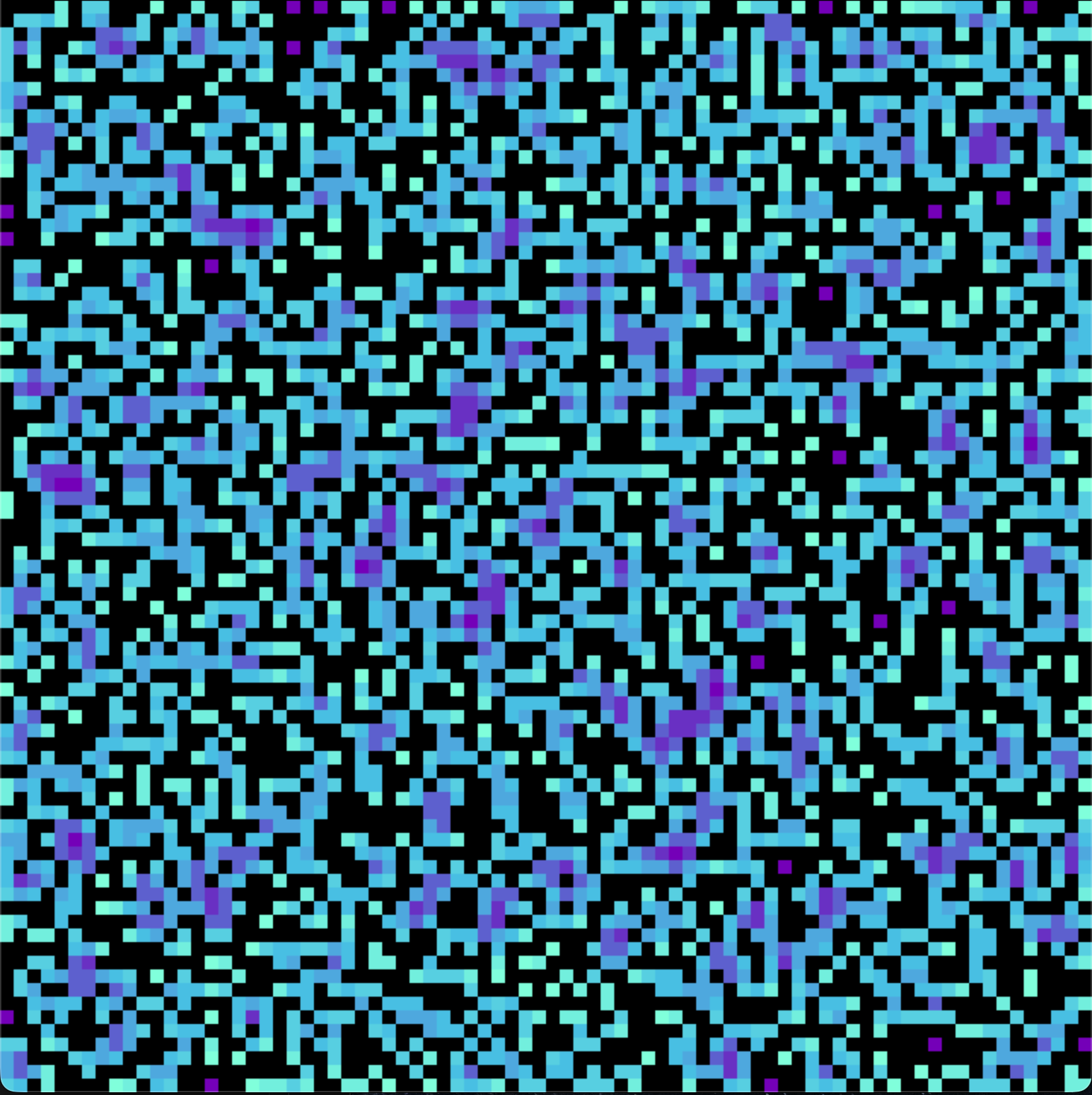
This is obviously just supposed to be a completely random noisy world that we’ll use to further produce better results.
The next step involves another function called caveify() which reduces noise by checking each cell and deleting it if it has less than 2 neighboring cells that are active.
def caveify():
    for c in range(COLS):
        for r in range(ROWS):
            if check_neighbors(board, r, c) < 2:
                board[c][r] = 0
After calling caveify a couple times, you’ll see that the world converges to a constant structure, in my case it looks like this:
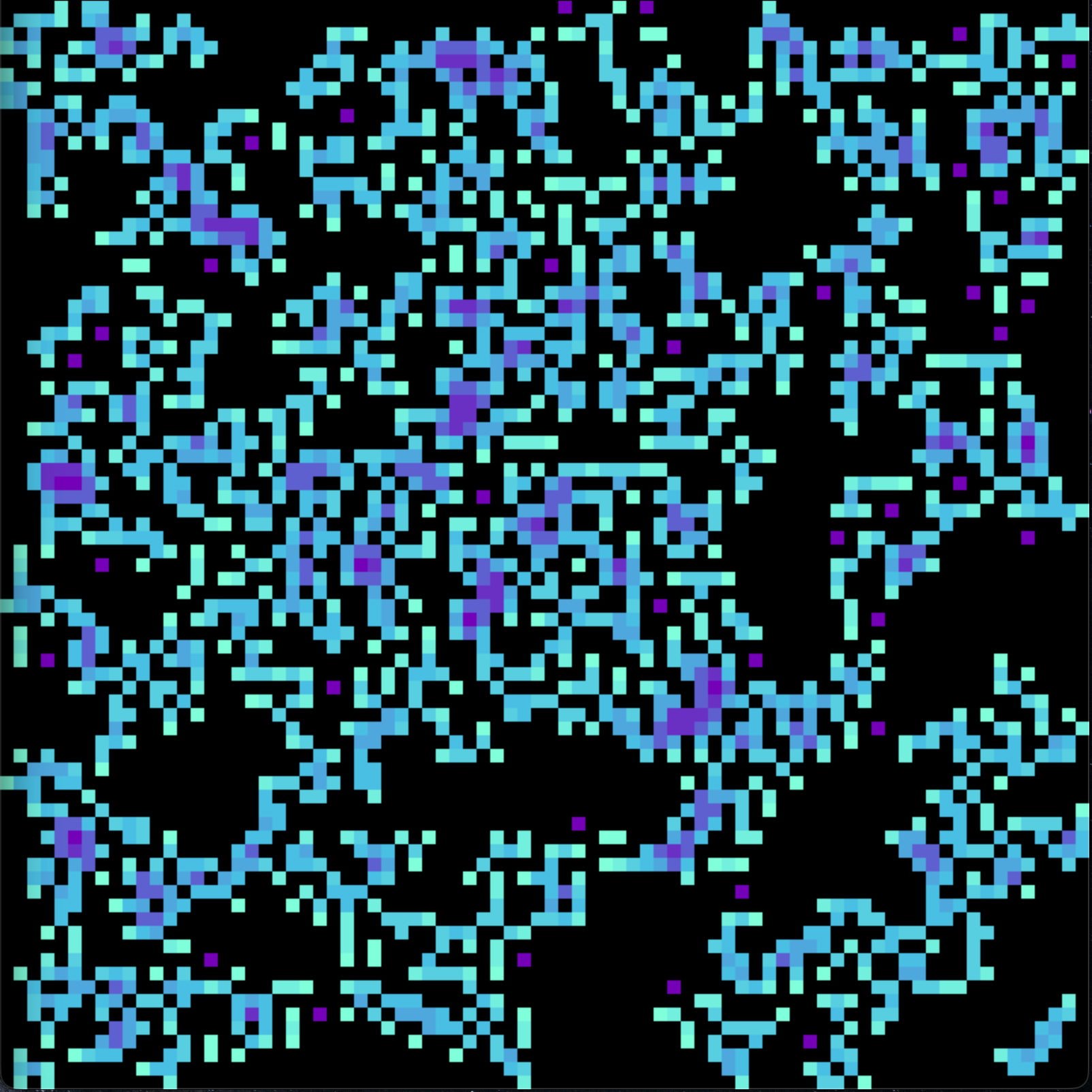
If you have a good eye, you might already be able to spot the issue I’m facing but I’ll move along anyways.
The next step in generation is to call the fill_holes() function, which aims to make the walls more solid, rather than having random
single cells of open air, creating real cave walls.
def fill_holes():
    for c in range(COLS):
        for r in range(ROWS):
            if board[c][r] == 1 and check_neighbors(board, r, c) > 4:
                set_neighbors(board, r, c, 1)
After a first pass of fill_holes() it should produce a structure similar to this:
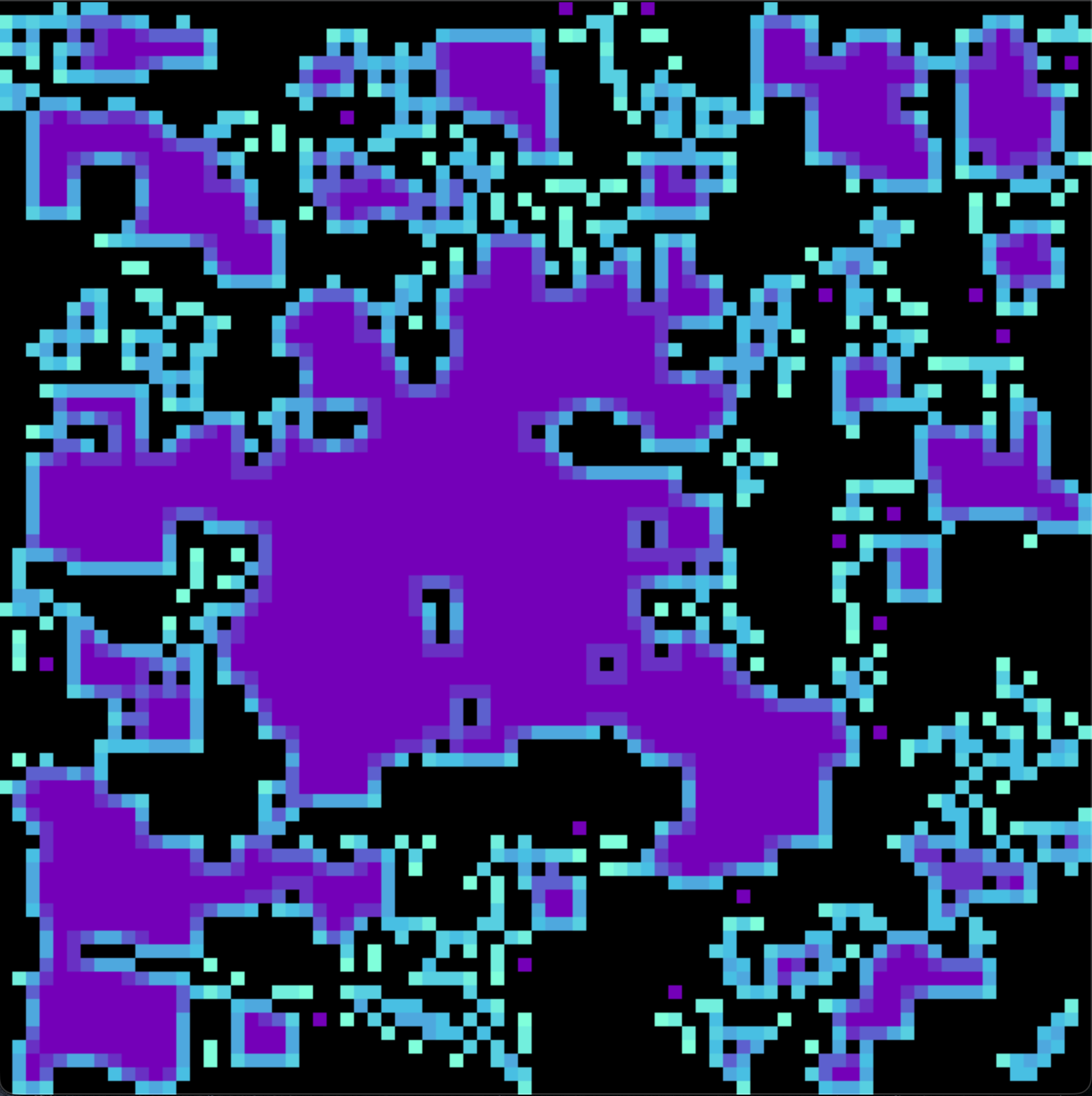
Note: We will make a couple passes of this function as well as the following function to further create smooth, solid walls.
Finally, we’ll use a function create_chambers() which makes cleaner chambers by deleting most floating singular or small groups of cells.
def create_chambers():
    for c in range(COLS):
        for r in range(ROWS):
            if board[c][r] == 0 and check_neighbors(board, r, c) < 2:
                set_neighbors(board, r, c, 0)
Which results in a structure like the following:
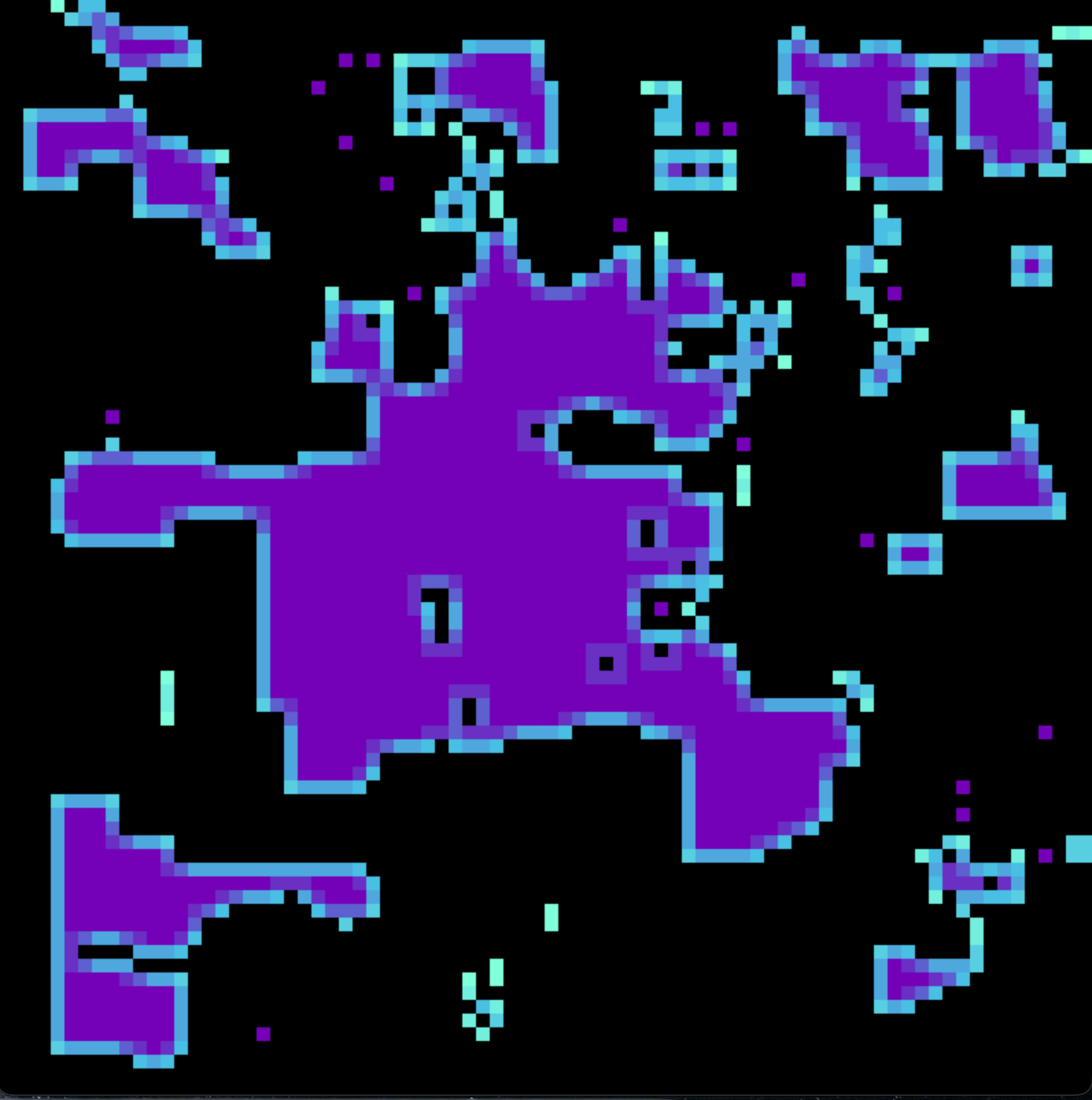
To me, create chambers comes off as a little too aggressive in deleting cells (I’m mid developing this when I found the issue I promise I’m getting to) so this may change in the future.
I like to go between fill_holes() and create_chambers() to taste which results in our final structure (which kind of looks like a lobster?):
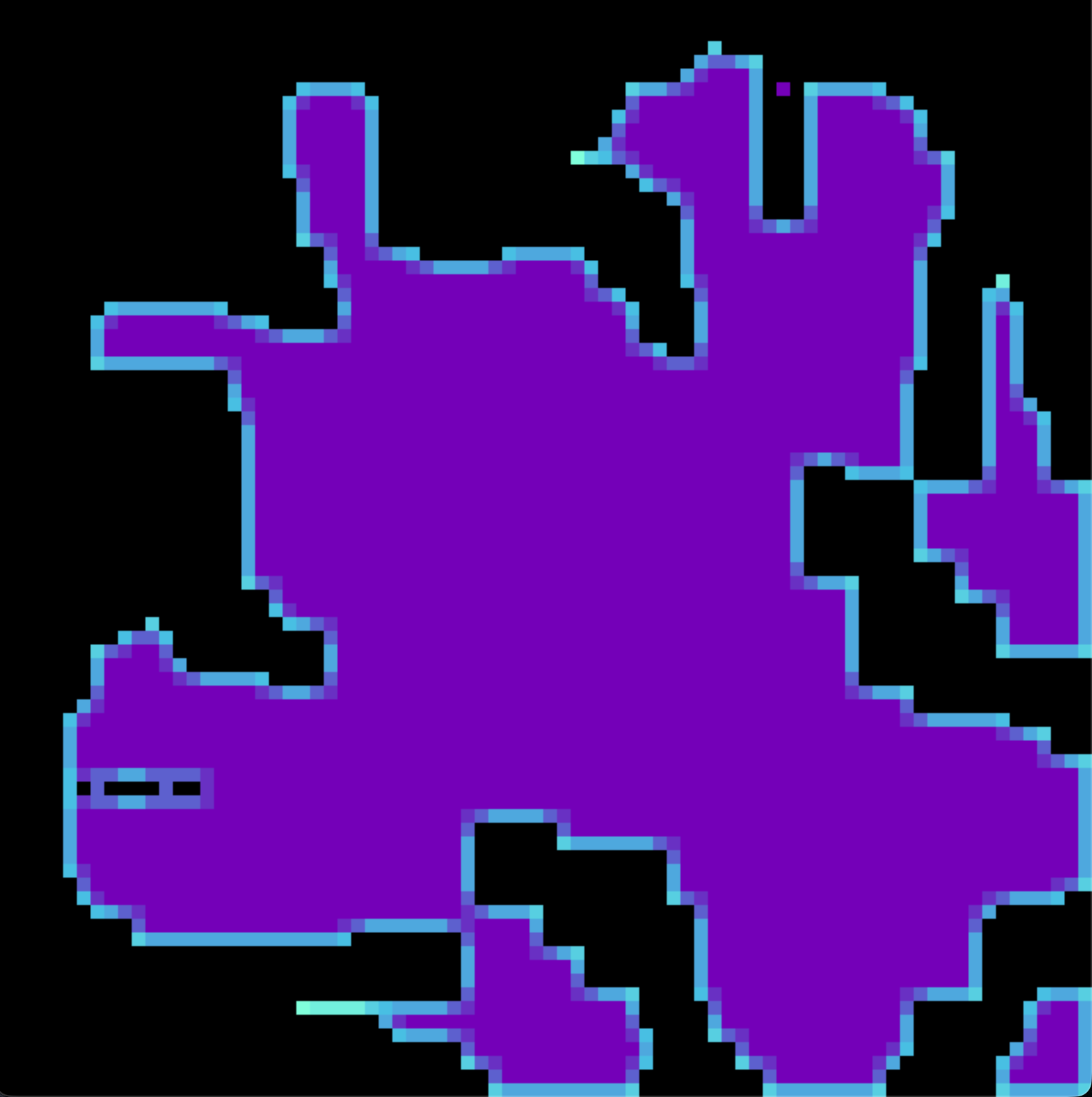
This structure is actually from a different run of the program (I accidentally restarted the generation)
The problem I’m running into now that it seems, no matter what random noise I generate from, that I’m getting structures that are nearly symmetrical along the diagonal. Here’s a few more to show you what I mean:
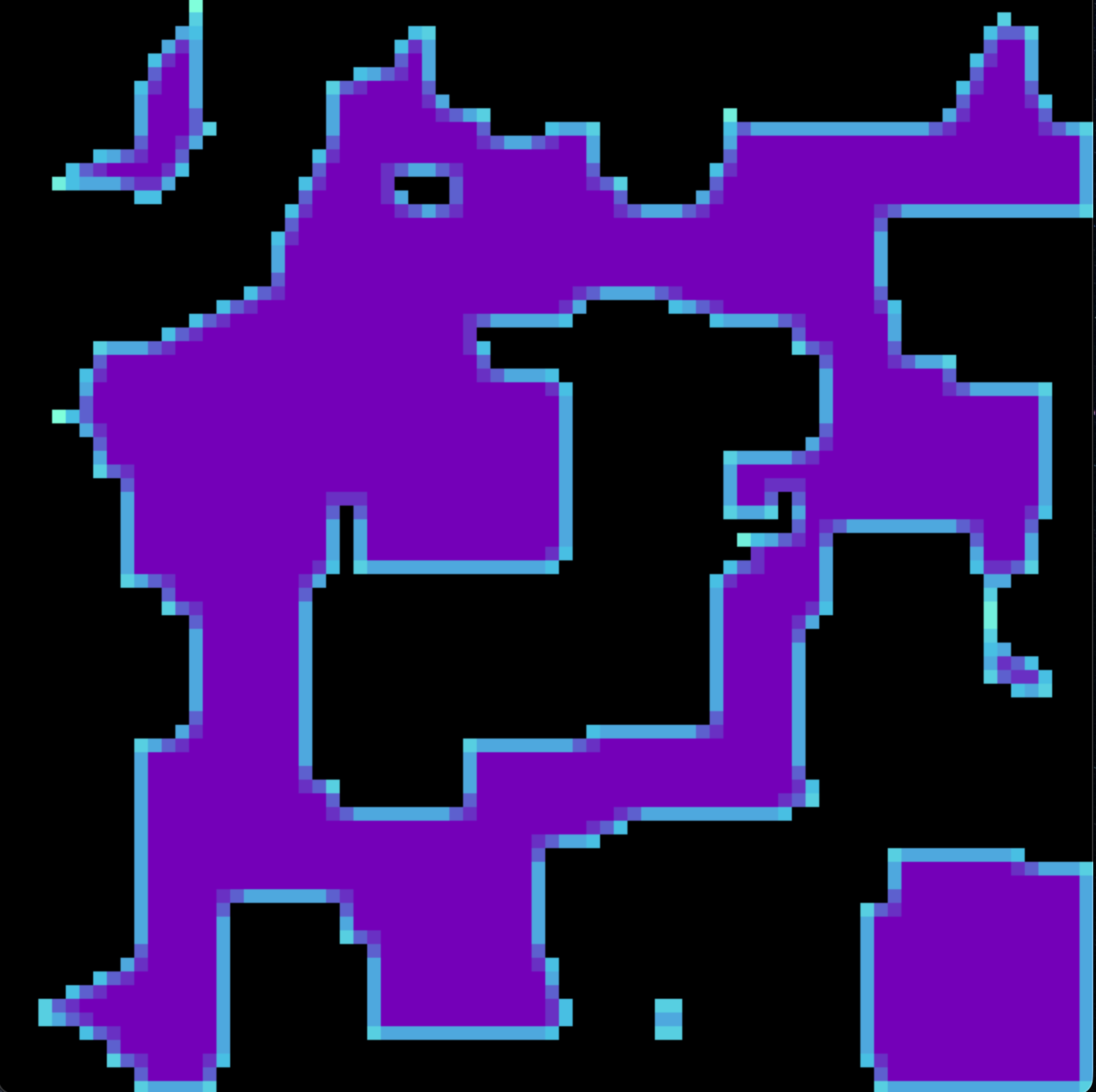

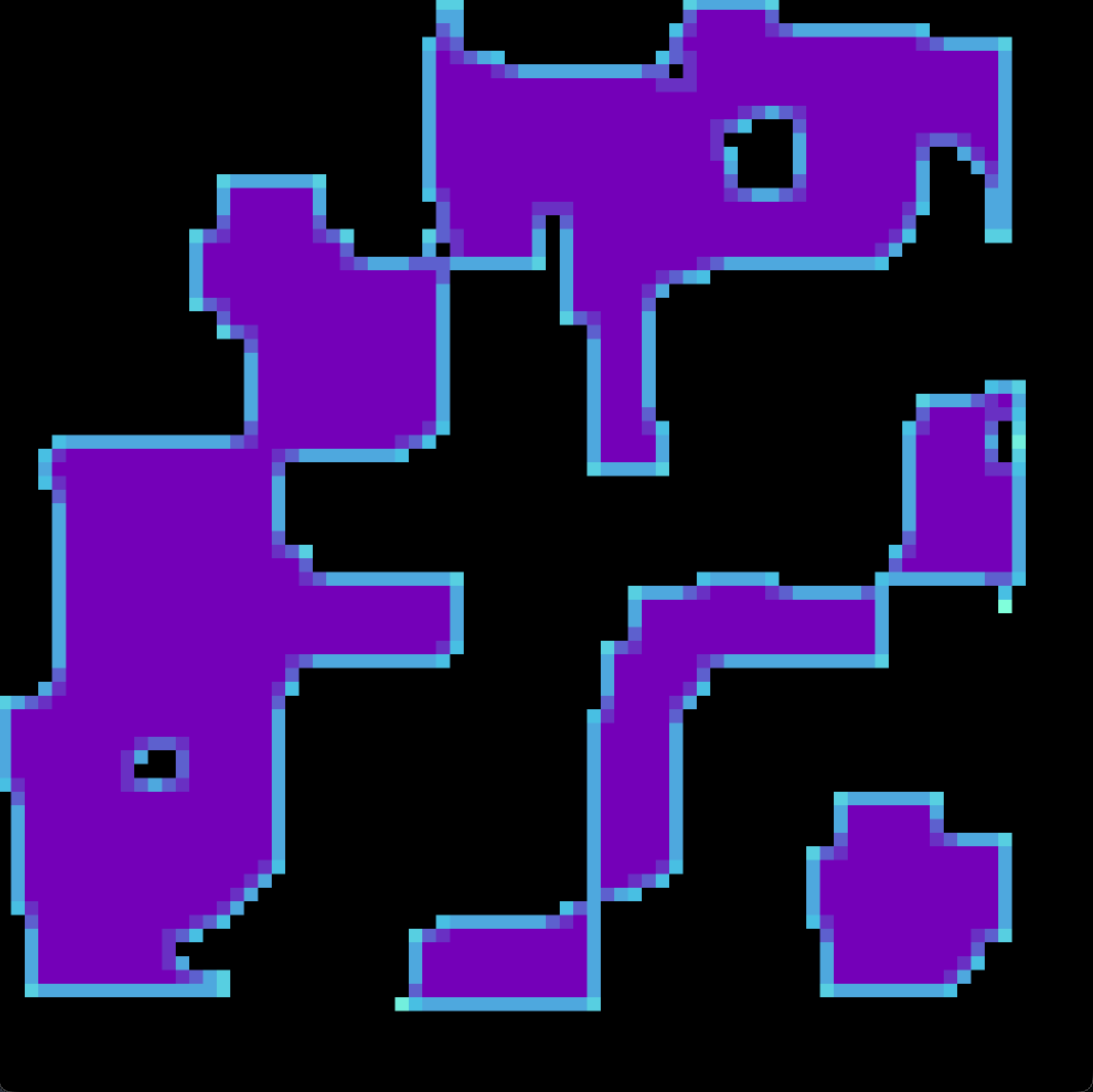
Maybe there’s a simple reason for this that I’m missing, but I don’t even know what I would google to understand what’s going on. I’ve tried different methods of pseudo-random number generation and I get the same results, so I wonder if its some blunder in my code.
Either way, if you’d like to help figure out what’s going on, add to the program, or just play with the generator itself, I have the repo on Github! The readme has instructions for installing and using the generator, and obviously let me know if you find anything cool! I’ll be sure to credit you and write a follow-up.